
R.T Stull - Alumina and Silica
R.T. Stull (Ray Thomas Stull) was an American ceramic chemist who created the famous Stull Chart (or Stull map) in 1912. This graphical tool plots the molar ratio of silica (SiO₂) to alumina (\(Al_2\mathcal{O}_3\)) from a glaze's Unity Molecular Formula (UMF) to predict fired surface qualities like gloss, matte, or crazing
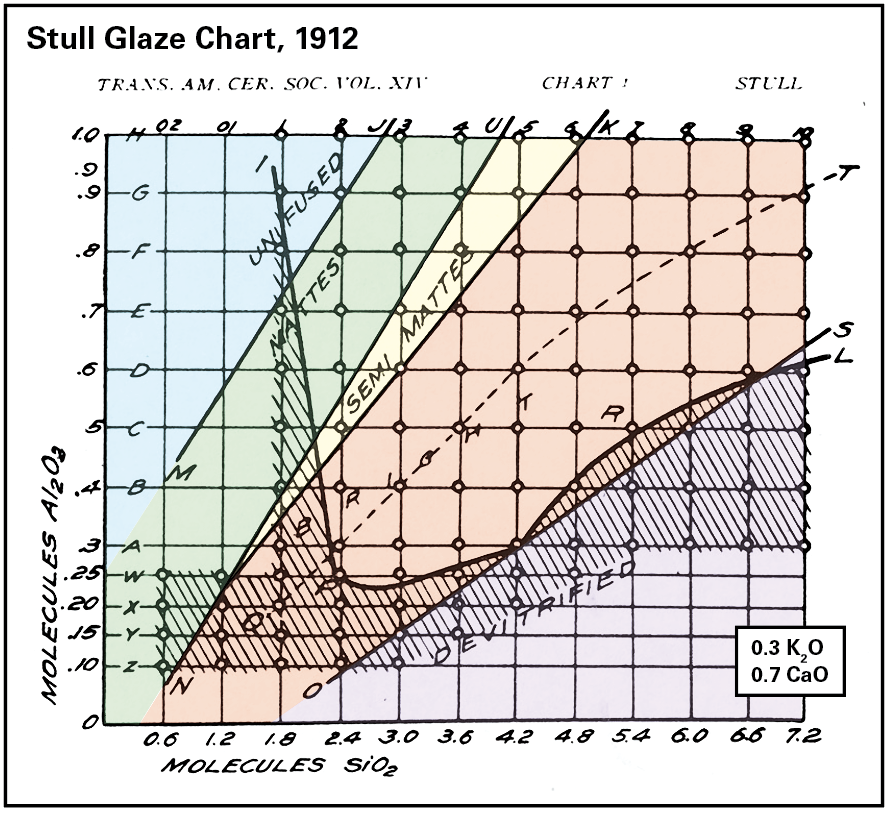
The Stull Chart Explained
The chart maps out how the relationship between two primary elements affects a ceramic glaze's final fired surface properties: [1, 2]
The Grid Axes: It plots the levels of Silica (SiO₂) on the X-axis against Alumina (Al₂O₃) on the Y-axis. [1, 2, 3]
The UMF Standard: The coordinates use the Unity Molecular Formula (UMF) system, which measures the proportions of molecules rather than raw weights. [1]
The Baseline: Stull developed his original map by keeping the glaze fluxes constant (specifically at a ratio of 0.3 R₂O : 0.7 RO) and firing them to Cone 11. [1, 2]
Glaze Prediction Regions
By looking at where a recipe plots on a modern digital version like the Stull Atlas app or Glazy, ceramists can accurately predict the following outcomes: [1, 2]
Matte Surface: Glazes with a low Silica-to-Alumina ratio (typically less than 4:1 or 5:1) will form a textured, matte finish due to micro-crystallization.
Bright / Glossy Surface: Glazes with a higher Silica-to-Alumina ratio (greater than 5:1, often peaking near 1:7.5) melt fully into a smooth, reflective glass.
Unfused / Underfired: Located at extreme corners where there is either too much alumina or too much silica to melt properly at the target temperature.
Crazed: Areas on the map where the thermal expansion mismatched between the glaze and clay body will result in fine spiderweb cracking. [1, 2, 3, 4, 5, 6, 7]
Modern Application
Even though it was created over a century ago for specific high-fire porcelain conditions, modern tools like the interactive web features on Glazy Help still rely heavily on Stull's boundaries. Potters frequently reference it to convert a glossy glaze into a matte glaze, troubleshoot fit issues, or stop a glaze from running off the piece